
Fascinating Fast Oil Experiments
Process trumps time: making crude oil out of prawns
The sedimentary rock record is dotted with enormous oil reserves, from the Gulf of Mexico to Saudi Arabia. In fact, it has been estimated that over one and a half trillion barrels of oil remains trapped between the earth’s sedimentary layers. But where did all this oil come from and how did so much of it end up in the earth’s crust?
The answer to the first question is simple. Oils are organic compounds made primarily of hydrocarbons (mainly carbon and hydrogen) found in the bodies of living organisms. The difficulty is understanding how this oil, trapped within living tissue, ends up forming the vast pools of “black gold” we see around the world.
Conventionally, oil is believed to have formed over millions of years, as microscopic plankton die and gradually settle to the bottom of ancient warm gentle seas. The plankton then mix with sediments on the bottom brought in by rivers. As further sediments slowly settle on top, the organic mix hardens into organic shale. As the shale becomes deeply buried under many kilometres of sediment, the shales are transformed into a substance called Kerogen by the increasing heat and pressure. The Kerogen is supposedly transformed into oil and natural gas between temperatures of 90 and 160oC. The oil then becomes trapped and accumulates beneath hard barriers of impermeable rock (usually shale) forming the huge underground reservoirs.
Time is clearly the hero of this standard story of oil formation. Without millions of years you can’t make oil, insist the secular geologists.
There are many problems with this view, however. Not the least of which, is the issue of decomposition. When animals and plankton die and fall to the bottom of the sea, they don’t simply wait around to be incorporated and buried in slowly accumulating sediments over millions of years. They are either eaten by scavengers or, more commonly, are decomposed by bacteria. To get around this, the secularists propose that oil can only form under anoxic conditions, environments devoid of oxygen and thus oxygen-dependent decomposing bacteria. Yet, there are microorganisms that can decompose organic substances without requiring oxygen. These are anaerobic organisms, and they are often used to treat sewage water. Additionally, the presence of clay within the oil-bearing shales tells us that high temperatures were not present during oil formation, as clay changes its nature when subjected to temperatures above 90 degrees.
Time is the enemy of oil formation! Time destroys organisms before they have a chance to become buried. There clearly has to be a process that can create oil quickly before the organisms decay complete.
It has already been shown by Creation Research that kaolin clay minerals found in many mudstones and shales catalyse the carbonisation of plant leaves into coal. It was therefore hypothesised that kaolin clay could also catalyse the extraction of oil from living tissues. To find out, a clay table was prepared by mixing Kaolin clay with deionised water. Five supermarket-bought king prawns were placed on the tablet and sealed in a vacuum-pack bag. The temperature was then maintained using a heat mat, keeping it at a low 35oC, too low to change the nature of the clay. Remarkably, within 24 hours, a thick black oil-like liquid was visible, surrounding the prawns.
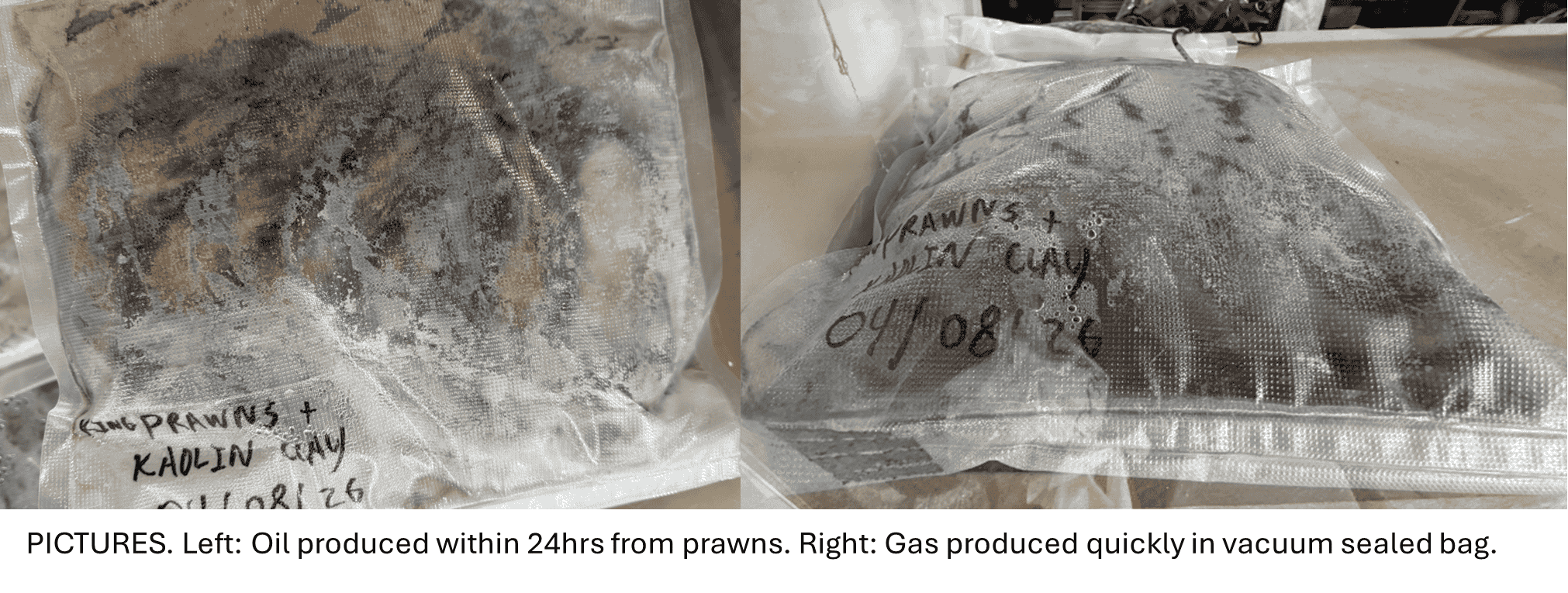
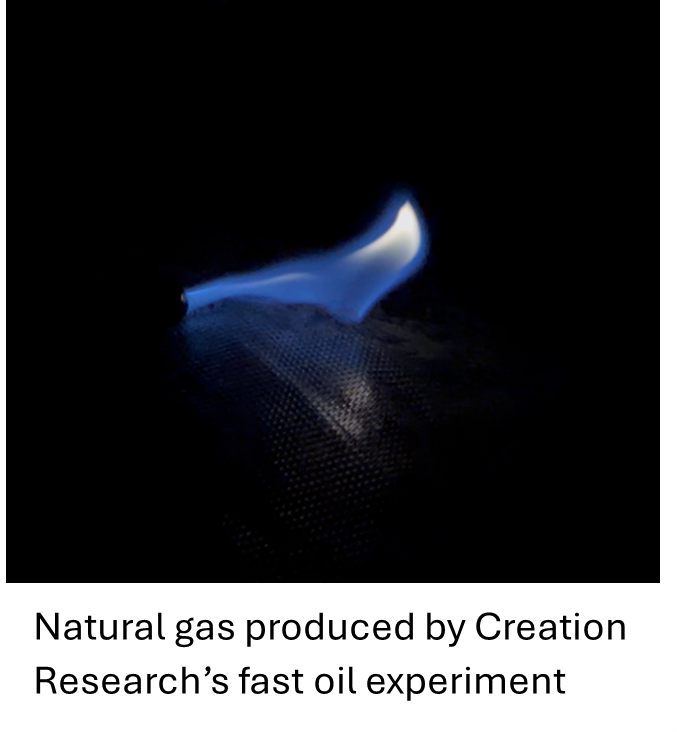
It was clear that the hydrocarbons locked away in the prawn tissues had been released. By 96 hours, the entire substrate around the prawns were jet black, oily, and beginning to pool. The bag was also bloated with gaseous, byproducts of the reaction. When the bag was pierced and the gas released, the gas was burnt, producing a bright blue flame. This shows that colourless, odourless natural gases (including methane) were produced from the reaction, without any extra contaminants, as the gas underwent complete combustion
The fact that oil was produced under air-tight conditions (i.e., no oxygen was present), strongly suggests the minerals in the kaolin clay were acting in the place of bacteria to release the oil and natural gas in a process similar to pyrolysis. It is interesting to consider that most oil tends to form in organic shales and mudstones, rocks that often contain minerals like kaolin. This experiment also shows that oil does not need to form between the high “oil window” temperatures of between 90 and 160oC, as is commonly stated in secular literature.
These findings open up a fascinating new branch of research into oil and natural gas production, suggesting that these fuels can be utilised as renewable energy resources.
Above all, however, they show that it does not take millions of years to produce oil and natural gas. Time is not the key, process is. That process seems to involve the use of kaolin clay mineral catalysts under low temperature anoxic conditions. This scenario matches what we would expect during the flood, as trillions of microscopic and macroscopic (large) sea creatures were buried under great thicknesses of rapidly accumulating sedimentary layers (many containing clay minerals)
Locked away in the sediments, these organisms would have been protected from the atmosphere and thus would have not had chance to decay. The oil and gas would have quickly been removed from the buried creatures by the clay mineral agents, before seeping through the porous sediments. On hitting a barrier of impermeable rock, the vast quantities of oil produced would accumulate, forming the huge oil fields present today. Process trumps time!
